


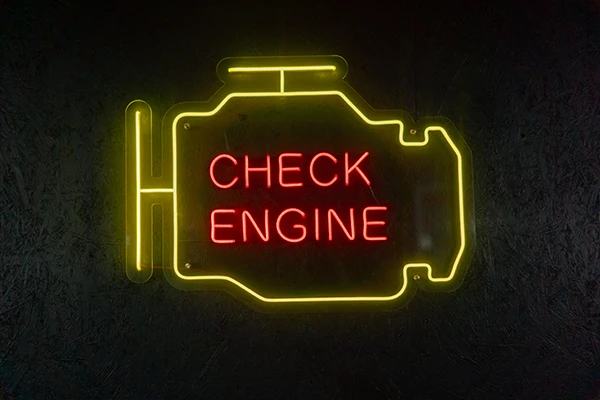
When you see an illuminated check engine light (CEL) on your vehicle’s dashboard, you’re immediately met with a wave of anxiety and stress. It’s easy to assume the worst when that dreaded yellow light comes on. The good news is that it isn’t always an indicator of a serious issue. There are a few common things that can cause the light to come on, some of which you can fix yourself without getting your hands dirty. In this article, we will go over the most common causes of a CEL and how to address them.
Common Causes of a Check Engine Light
Loose or Worn-Out Gas Cap
Every component of the fueling system in your car, from the gas tank to the fuel injectors, is sealed to prevent the escape of environmentally harmful emissions. If you get a code and don’t fully screw the cap on, you will likely trigger a check engine light for evaporative emissions. Ensuring the cap is tight will eliminate the code. If your car is older, the cap’s seal can wear out, leading to a check engine light. In this case, the cap will need to be replaced.
Catalytic Converter Issues
The Catalytic converter reduces tailpipe emissions. This device sits in the exhaust, removing some of the harmful emissions produced by combustion and converting them to relatively harmless ones through a chemical reaction. A failing catalytic converter can cause a check engine light, reduced performance, and poor fuel economy. In Texas, you won’t pass an emissions test with a failed/missing converter.
Spark Plugs and Ignition Coils
A faulty/failing ignition system triggers the check engine light to come on. If the plugs are bad enough, you may experience a misfire, which happens when the air/fuel mixture in the cylinder is not ignited. If you experience a misfire, stop driving your car immediately to prevent potentially catastrophic damage to the engine or catalytic converters.
Spark plugs are universal across all gasoline engines, but the ignition system will vary from vehicle to vehicle and overall age of the model. Older vehicles may use a coil pack, ignition coil, or distributor. If any part of the ignition system prevents the spark plug from firing properly, likely turn on the check engine light in the process.
Timing Problems
The pistons, crankshaft, cylinder head, camshafts, and valvetrain need to stay in perfect time with one another to run. Timing is achieved with a belt or chains, and these items will naturally wear out after tens of thousands of miles of driving.
Oxygen Sensor Problems
If your car’s oxygen sensor (also referred to as an O2 sensor) is malfunctioning, it won’t be able to determine how much oxygen is in the exhaust, which means your vehicle won’t deliver the correct amount of gasoline to your engine. These sensors tell the ECU how efficiently your vehicle is running, and whether or not the catalytic converter is working properly.
Get That Check Engine Light Checked Out!
All of the problems we have mentioned in this article sample the more common causes of a check engine light. And due to your vehicle’s internal computer being sensitive, it’s virtually impossible to know what’s wrong based on the light by itself.
Check Engine Light Diagnostics in Spicewood, TX
The check engine light can be illuminated for many reasons, from a simple vacuum leak to a potentially damaging misfire or timing problem. The technicians at Vineyard Bay Automotive have years of experience diagnosing check engine lights. Our shop has the proper diagnostic tools that make getting to the bottom of the problem quick and easy. We’re located at 22111 State Highway in Spicewood, Texas. Give us a call or schedule an appointment online, and let us diagnose your check engine light today!